

Historical Elements from a Continental European Perspective
Is the Rite of Memphis-Misraïm regular or recognized within so-called “mainstream” Freemasonry?
Ah, the famous question of Masonic regularity… and the equally famous issue of the legitimacy of so-called “exotic” rites.
The question returns endlessly, in all its forms: Is it regular? Is it recognized? By whom? Since when? One might think that Freemasonry could be defined solely by official seals, recognition lists, and carefully guarded symbolic boundaries.
Recognition, regularity, legitimacy — these terms overlap, blur, and sometimes collide, often generating more misunderstanding than clarity. And whenever the Rite of Memphis-Misraïm enters the conversation, these questions seem to multiply. Before attempting an answer, it is necessary to step back and calmly examine what these words have historically meant within Freemasonry — and what they are sometimes made to mean today.
An old Anglo-Saxon Masonic saying may serve here as a guiding thread: “Meet on the level and part upon the square.” To meet on the level is to acknowledge that we share a common origin and a common intention. To part upon the square is to recognize that this intention may unfold through different forms, inheritances, and traditions.
To part does not mean to oppose one another; it simply means remaining faithful to one’s own form without denying the legitimacy of another. The question of legitimacy or “regularity” in Freemasonry is often framed as though there were a single, universal, and unchanging definition of what Masonic regularity is supposed to be.
Historically, this is not the case.

Masonic Regularity in Its Historical Meaning
In early Masonic tradition, regularity did not refer to institutional recognition, but to a simple and practical initiatory reality. As Edmond Gloton explains in Instructions maçonniques aux Apprentis (“Masonic Instructions for Apprentices”, 1934), a Mason is considered regular if he has been regularly initiated.
But what does this regularity mean?
Very simply: to make a Mason, seven regularly initiated Master Masons are required. And what is a regularly initiated Master Mason? A man who has himself been initiated by seven regularly initiated Master Masons. Nothing more. Nothing less.
Initiation sustains and generates itself — somewhat like an Ouroboros..
A Logic of Transmission, Not of Central Authority
This definition rests upon a self-perpetuating chain of initiatory transmission. In its original sense, regularity therefore concerns continuity, lineage, and practice — not membership in a single central authority.
However, the word “regularity” did not remain confined to this initial meaning. Over time, it came to designate other realities.
First, beyond transmission itself, it was expressed through what the Anglo-Saxon tradition would later call “landmarks”: fundamental principles intended to define the conditions of regular Masonic work — the use of traditional symbols, the presence of the Volume of the Sacred Law in the lodge, the ritual framework, and the discipline of the lodge.
Later still, in a more institutional development, regularity became associated with criteria of recognition between Grand Lodges: The Basic Principles. In that context, a Grand Lodge may be considered regular not only because of its initiatory practice, but because it satisfies formal conditions allowing it to be recognized by other jurisdictions.
Thus, three distinct levels gradually emerge:
- Initiatory continuity,
- Conformity to structuring principles,
- And institutional recognition.
These levels do not coincide, even though they are often conflated in contemporary debates. The concept of regularity therefore encompasses different realities and successive historical evolutions. It cannot be reduced solely to institutional recognition. There are lodges and Grand Lodges in the world that work according to principles traditionally regarded as regular — including with respect to the landmarks — yet are not recognized by certain Grand Lodges for administrative, territorial, or geopolitical reasons. Recognition, in itself, is not the absolute measure of initiatory regularity.
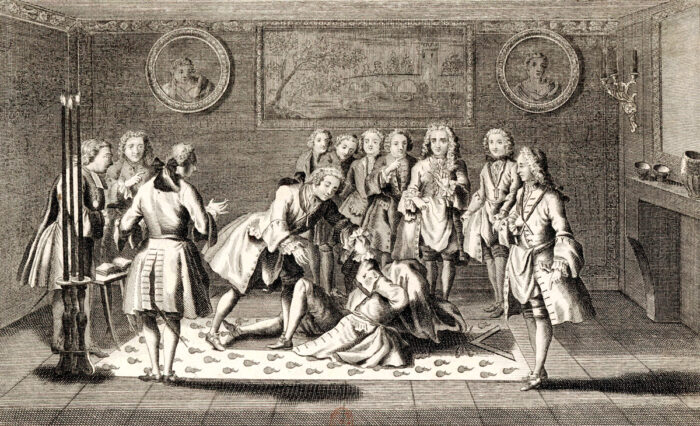
An Analogy Helps Clarify This Distinction
To claim that a Mason would only be legitimate if recognized by a particular Masonic authority would be equivalent to claiming that a bishop is only truly a bishop if consecrated by the Roman Catholic Church.
Historically, this is incorrect. Orthodox, Coptic, and other Eastern Churches possess a recognized and traceable apostolic succession without depending on Rome. Institutional recognition and traditional legitimacy are not the same thing.
The same applies to Freemasonry. According to cultural areas — British, continental European, Mediterranean, Latin American, or North African — different conceptions of regularity and legitimacy have developed. The Anglo-Saxon concept of regularity is one historical construction among others. It cannot reasonably be elevated to the status of a universal measure of initiatory legitimacy.
Some observers are inclined to interpret certain continental or Mediterranean traditions as having developed in opposition to London, sometimes viewing them as symbolic extensions of the Napoleonic rivalries between France and Great Britain. The temptation is understandable: the nineteenth and twentieth centuries were marked by political, cultural, and imperial tensions that also influenced the institutional forms of Freemasonry. Yet reducing these traditions — and particularly Memphis-Misraïm — to a posture of opposition would be historically inaccurate.
The Rite developed within its own cultural sphere, through Naples, Italy, France, and Cairo, within an environment shaped by Hermeticism, higher degrees, and a distinctive esoteric sensibility. It was not constructed “against” a model, but according to different historical and spiritual trajectories. It is not the contestation of a norm; it is the expression of a distinct lineage within Masonic plurality.
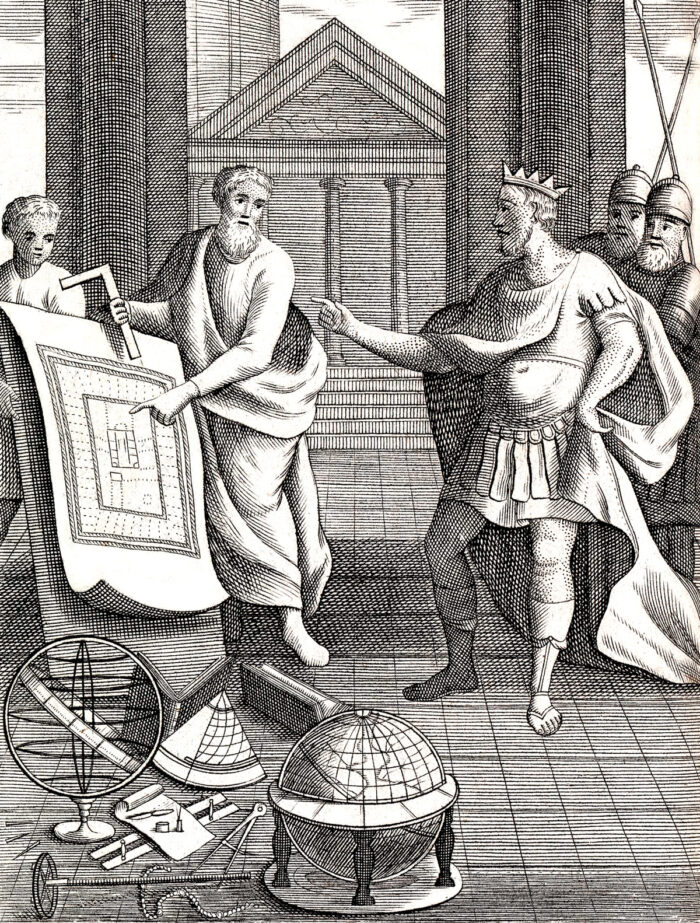
London and the Modern Structuring of Freemasonry
Recognizing this plurality of levels of regularity does not in any way diminish the decisive historical role played by London. The formation of the Grand Lodge of London and Westminster profoundly shaped modern Freemasonry at the institutional and organizational levels.
Masonic initiation, however, predates this structuring. The Grand Lodge did not invent Masonic initiation; it organized, rationalized, and standardized forms that already existed. It was within this context that English workings later emerged — Stability first, then Emulation — with the aim of harmonizing practices and ensuring institutional coherence.
These developments responded to specific historical needs. They contributed significantly to stabilizing usages, standardizing certain practices, and disseminating an organized Masonic model that has largely shaped the modern Freemasonry we know today.
A Mason concerned with historical rigor will nevertheless distinguish between these organizational intentions and the older, deeper realities of initiatory practice.
Ordo or Chaos?
It would be simplistic to draw a sharp opposition between centralization and decline, as though the absence of uniformity would inevitably lead to excess or irrationality. Historically, the effort to standardize practices also responded to a legitimate concern: preventing deviations, maintaining a shared framework, and preserving doctrinal and symbolic coherence. From this perspective, centralized forms have played a genuine stabilizing role.
Yet this logic reaches its limits when it confuses guarantee with uniformity. A living initiatory tradition is not necessarily a single tradition. History shows that diversity in practices, languages, and sensibilities does not prevent transmission or depth, provided that lineages are identifiable, documented, and traceable. It is not plurality that generates deviation, but opacity.
One might draw a parallel here with the early Christian communities: multiple, local, sometimes quite different in their forms of expression, yet still part of a coherent spiritual tradition before dogmatic centralization. In the same way, initiatory Freemasonry cannot be reduced to a single model. It gains richness when its lineages are clear, assumed, and historically grounded.
It would also be misleading to present such diversity as a purely continental phenomenon. The Anglo-Saxon world itself encompasses a plurality of ritual forms and traditions: the different Craft workings such as Emulation or Stability in England, the Standard Scottish Rite, the York Rite, and the Ancient and Accepted Scottish Rite. This internal diversity is not regarded as a challenge to regularity, but as an expression of the richness inherent in Masonic tradition.
In that light, continental forms such as the Rite of Memphis-Misraïm, the Rectified Scottish Rite, or the Strict Templar Observance are not anomalies within Freemasonry. They belong to the same historical dynamic of adaptation, development, and transmission characteristic of any living tradition. Their existence does not contradict the idea of regularity; it simply manifests it through different lineages and sensibilities.
It is within this framework — that of an initiatory tradition both structured and plural — that the case of the Rite of Memphis-Misraïm should be approached. Not as a marginal exception, but as the expression of a particular lineage within a historically diverse Masonic landscape.
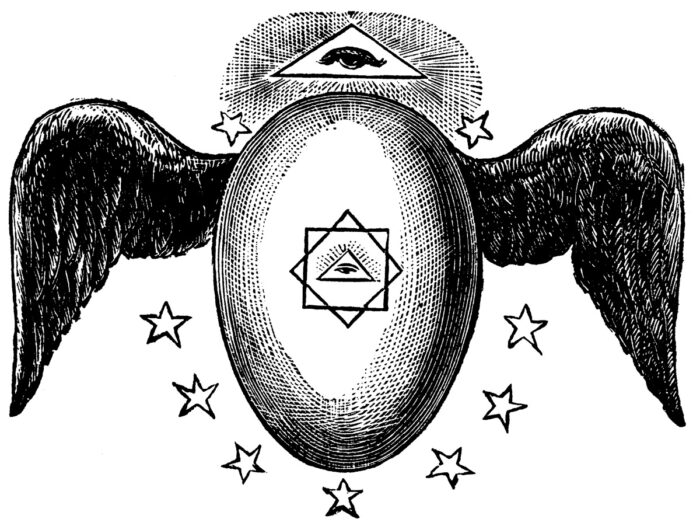
Memphis-Misraïm: Plurality of Origins and Continuity of Lineages
The Rite of Memphis-Misraïm does not constitute a monolithic body originating from a single source. It was formed through the convergence of several influences, lineages, and filiations emerging from different geographical, cultural, and historical contexts. This diversity is intrinsic to the Rite’s history.
What matters today is that these lineages are identifiable, documented, and historically traceable. We know who transmitted what, to whom, and in which contexts. The initiatory chain rests upon actual transmissions rooted in time.
In terms of practice, the Rite operates within the traditional symbolic framework of Freemasonry: invocation of the Great Architect of the Universe, the presence of the Volume of the Sacred Law in the lodge, the use of fundamental symbols, adherence to a structured ritual framework, and the gradual transmission of degrees. It is therefore not a marginal innovation, but a particular expression of a common Masonic matrix.
In this respect, the situation is comparable to the apostolic lineages mentioned earlier: a succession does not need to be centralized in order to be legitimate, provided that it is continuous, recognizable, and historically attested.
Conclusion
From this perspective, the Rite of Memphis-Misraïm is neither an anomaly nor a recent construction assembled from disparate elements. It belongs to a continental European esoteric tradition with its own history, internal coherence, and specific modes of transmission — often evaluated according to criteria that were not originally designed for it.
This reading does not demand adherence or approval. It simply invites us to place contemporary debates back into their historical context and to distinguish clearly between initiatory continuity, structuring principles, and institutional recognition.
It is not a matter of exhausting every possible origin of the Rite, nor of claiming to offer an exhaustive history of Memphis-Misraïm in all its expressions. It is simply the history that concerns us directly — the one we can document, assume, and work within. Each may then pursue his own research further. For a living initiatory tradition is never closed upon itself.
Perhaps, then, it is time to return to the old Masonic saying that opened this reflection: “Meet on the level and part upon the square.” To meet on the level — not in order to impose uniformity, but to acknowledge a shared origin and intention. To part upon the square — not as adversaries, but as Brethren remaining faithful to their respective forms, in mutual respect for one another’s lineages.
Masonic plurality need not be a field of confrontation. It may become a space of mutual enrichment, provided that we clearly distinguish between transmission, principles, and recognition.
It may be that contemporary debate is now called to that level of maturity.
To go further
- Edmond Gloton, Masonic Instructions for Apprentices (1934) – MdV
- Wikipédia – Régularité maçonnique
- Wikipédia – Rite de Memphis-Misraïm
- Origines du Rite Ancien et Primitif de Memphis-Misraïm
The above references are provided for informational and cultural purposes only. There is no commercial relationship with the authors, publishers, or platforms mentioned; these links are not advertisements, but rather further reading intended to provide more in-depth information on the subject matter.
Where possible, the images used to illustrate these articles are systematically accompanied by a reference to their source and credits. Where no source is indicated, this is because the information was not available. These images are used solely for illustrative purposes, in a non-profit context, without any commercial intent or appropriation of the work.