
Introduction
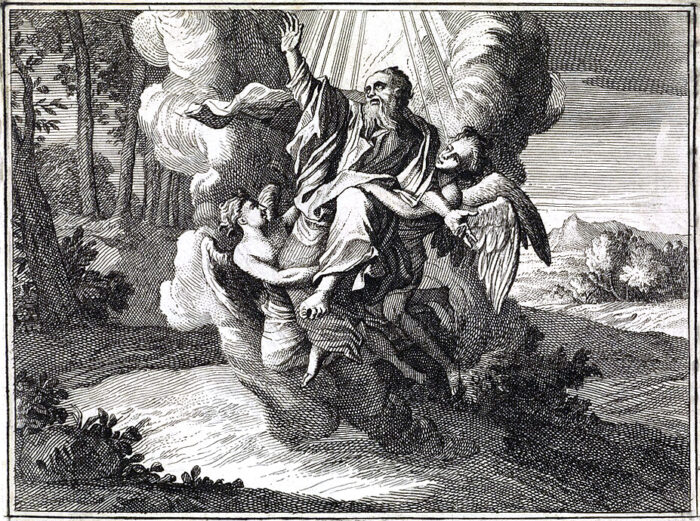
Freemasonry often presents itself as the heir to several traditions: Solomonic, Adoniramite, Enochic. These words are spoken with gravity. They suggest an ancient lineage, roots planted deep within a long memory. Yet if many Brothers and Sisters were asked what the expression “Enochic tradition” truly means, the answers would often remain imprecise. The name of Enoch is familiar. The figure itself remains indistinct. It is invoked as though self-evident, without always knowing what that reference actually entails.
Why return to Enoch, then? Why devote a new article to a figure already widely discussed, sometimes appropriated, often distorted? Precisely because beneath layers of interpretation, vague esotericism, and sensational speculation lies a tradition of remarkable depth, too often misunderstood.
In the Western biblical canon as it is most commonly received today, only a few words are devoted to this man. A brief, almost enigmatic sentence: he “walked with God,” and then “he was no more.” No account of death. No burial. No further development. A disappearance. This brevity has fascinated generations of readers. It created a space. And that space was inhabited.
It must be noted, however, that this discretion concerns the biblical canon as it took shape in the West. In other traditions—most notably within the Ethiopian Orthodox Church, where the Book of Enoch remains part of the biblical canon—the figure is not marginal. Yet it was precisely from the sobriety of the Genesis account, in its Western reception, that an extensive literary development unfolded.
Over several centuries, within ancient Judaism, authors expanded his story, described his visions, recounted his ascents into the heavens, his dialogues with angels, and his transformation. What had been a single line became a world. What had been a mere mention became a literature.
The Book of Enoch is often described as an “apocryphal” writing, almost peripheral. The reality is more complex. This text circulated within Second Temple Judaism, influenced certain early Christian circles, and remains canonical within the Ethiopian tradition. It is neither a late fantasy nor an exotic curiosity. It stands as a witness to an ancient religious reflection on justice, evil, knowledge, and the transformation of the human being.
To return to Enoch, then, is not to indulge in easy mystery or to encourage fanciful readings. It is to rediscover a figure that shaped centuries of spiritual thought—and, for Freemasonry itself, to examine seriously what it means to claim inheritance from an Enochic tradition.
The Three Enochic Corpora
We often speak of the “Book of Enoch” as though it were a single, compact text transmitted intact from Antiquity. The reality is far more nuanced. What is now called the Enochic tradition in fact corresponds to three distinct bodies of literature, composed in different periods and preserved through different channels of transmission.
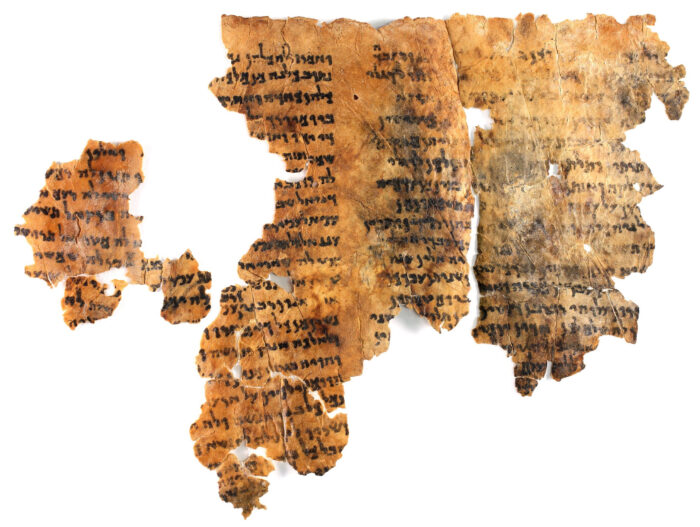
The earliest is what is commonly referred to as the Book of Enoch, sometimes called 1 Enoch. It was composed several centuries before the Common Era, within the context of Second Temple Judaism. Fragments in Aramaic were discovered among the Dead Sea Scrolls, showing that it was already circulating within certain Jewish circles in the second century BCE. The text likely existed in Greek, yet it is in Geʽez — the liturgical language of Christian Ethiopia — that it has been preserved in its entirety. To this day, it remains part of the biblical canon of the Ethiopian Orthodox Church. We are therefore far from a marginal or late writing: it belongs to a decisive moment in ancient Jewish religious thought.
The second corpus, known as the Second Book of Enoch, or 2 Enoch, is more difficult to situate with precision. It appears to have been composed in the first century CE, probably in Greek, within a Jewish milieu already shaped by Hellenistic culture. Yet it survives only in medieval Slavonic manuscripts copied centuries later. The term “Slavonic” therefore does not designate its original language, but the language through which it was transmitted. Its preservation took place within Eastern Christian contexts, particularly in Eastern Europe.
Finally, the Third Book of Enoch, or 3 Enoch, belongs to a markedly different intellectual climate. Written in Hebrew between the third and sixth centuries CE, it is associated with the Jewish mystical tradition of the Hekhalot, the literature of the “Heavenly Palaces.” Here we are no longer within early Jewish apocalyptic literature, but in a more developed mystical speculation, transmitted in rabbinic or para-rabbinic circles and later copied in medieval manuscripts.
These are therefore not three versions of a single book, but three successive moments in the unfolding of a figure in motion. Through them, several centuries of religious reflection emerge, each rereading in its own way the brief biblical mention of a man who “walked with God.”
An Enochic Current
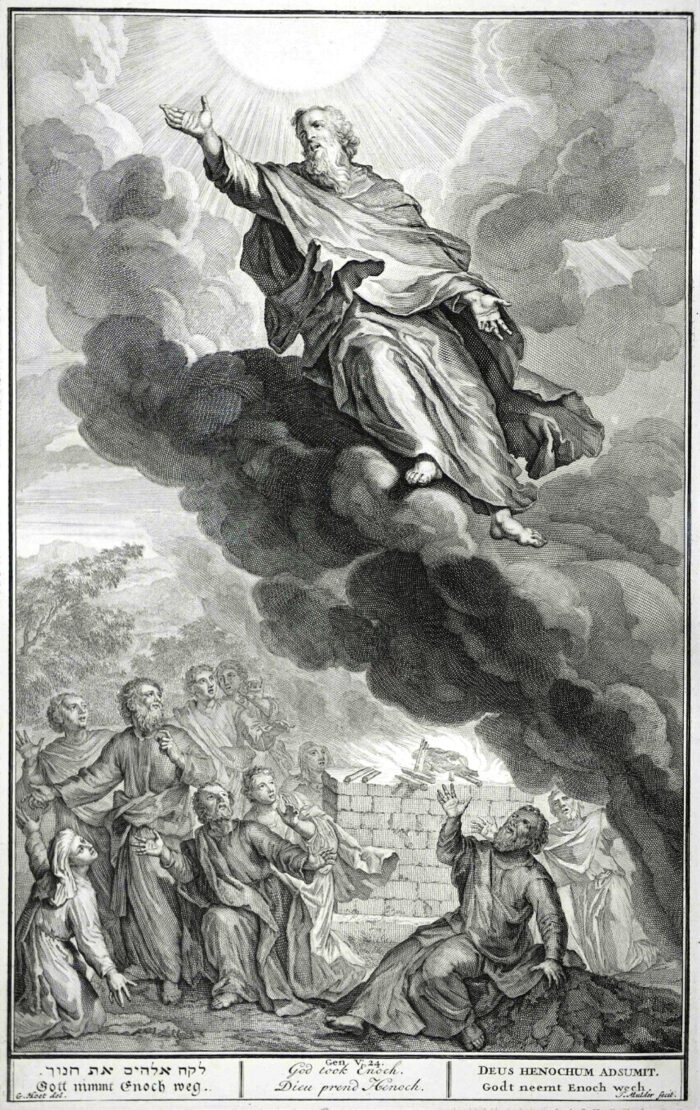
Although these three corpora belong to different historical contexts, they do not emerge from disconnected worlds. A shared symbolic core runs through them: Enoch’s ascent, the unveiling of the heavens, the proximity to the divine sphere. From one text to another, the setting shifts and the details vary, yet the trajectory remains the same: a man crosses the ordinary limits of the human condition.
Rather than a single text unfolding into successive versions, it is more accurate to speak of an Enochic current — a sustained literary stream that, over the centuries, rereads and deepens the same fundamental intuition.
This current is not merely a repetition of themes. It testifies to a persistence: that of a question that continually returns. How can proximity to the divine be conceived without dissolving what is human? How can access to higher knowledge be described without tipping into excess? The figure of Enoch thus becomes a theological and symbolic laboratory, where different ways of articulating elevation are explored without erasing the human condition.
The Evolution of a Figure
What strikes the reader when moving through these corpora is not only their diversity, but the gradual transformation of the figure of Enoch himself. From one text to another, he does not remain the same. He grows.
This growth was not without debate or tension. Not all ancient Jewish circles received these developments in the same way. Some integrated the figure of Enoch into their apocalyptic or mystical reflections; others left him at the margins. The Enochic tradition was therefore never an uncontested dominant current, but a particular line—sometimes debated, sometimes marginalized—that nonetheless endured across the centuries.
In Genesis, Enoch is simply a righteous man. He preaches nothing, founds nothing, fights no one. He “walks with God.” The formula is spare, almost austere. It suggests closeness, fidelity, a quality of relationship. Then he disappears. That is all. This initial restraint matters: Enoch is not a spectacular hero. He is, first and foremost, a man inwardly aligned.
With the Book of Enoch, the perspective shifts. Enoch becomes a visionary. He contemplates the secrets of the heavens, witnesses the judgment of the fallen angels, and receives revelations concerning cosmic cycles. He is no longer merely a righteous man: he becomes a witness to an unseen order. The world is no longer perceived as a simple earthly stage, but as a reality structured by spiritual forces. Enoch becomes a mediator between heaven and earth.
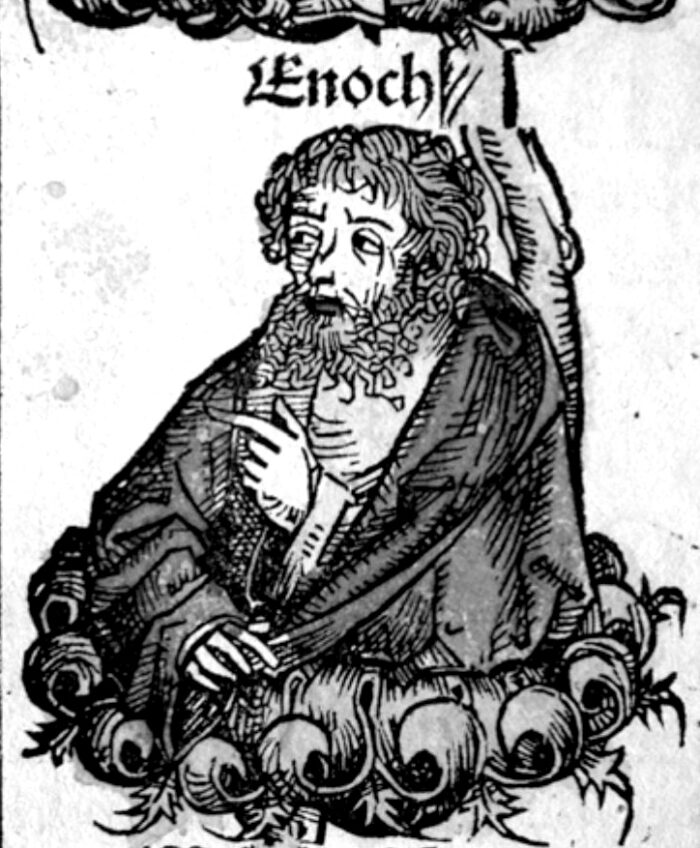
In the Second Book of Enoch, this dimension intensifies. The narrative portrays his ascent through multiple heavens. He passes through spheres, encounters celestial beings, receives instruction. The structure of the universe becomes more clearly articulated. Enoch is no longer only the one who sees; he is the one who journeys. The experience becomes passage, traversal, deepening.
Finally, in the Third Book of Enoch, the transformation reaches its culmination. Enoch is identified with Metatron, an angelic figure, celestial scribe, one who stands close to the Throne. The man who “walked with God” becomes the symbol of an extreme proximity to the divine sphere.
What remains constant throughout these centuries of writing and rewriting is therefore not a fixed narrative, but an orientation. Enoch is always the one who crosses a threshold. He does not merely observe the world: he moves through its levels. He does not simply undergo the cosmos: he discovers its structure.
Enoch and Freemasonry
It is therefore not surprising that a figure such as Enoch found an echo within certain modern initiatory traditions. When Freemasonry, in the eighteenth century, developed its higher and side degrees and deepened its symbolic narratives, it drew extensively from biblical and para-biblical imagery. In this context, Enoch appears not as a secondary character, but as a figure of transmission.
In certain developments associated with these degrees, Enoch is linked to the idea of a preserved deposit, of knowledge safeguarded from the corruption of time, of a memory concealed yet not lost. He becomes the one who, before the ruptures of history, entrusted to the depths what was not meant to disappear.
This is not to claim a direct historical continuity between the Enochic writings of Antiquity and modern Freemasonry. It is rather a symbolic reappropriation. The figure of Enoch offers a powerful language through which to think transmission, verticality, and the preservation of a principle beyond catastrophe.
This reappropriation belongs to the intellectual climate of the eighteenth century, marked by renewed interest in ancient biblical texts, para-biblical traditions, and Antiquity more broadly. The higher and side degrees emerged in a context in which these ancient figures were rediscovered, reinterpreted, and symbolically reshaped as vehicles for moral and initiatory teaching. Enoch was therefore not transmitted as a direct historical inheritance, but chosen for the strength of his imagery and the richness of his symbolic reach.
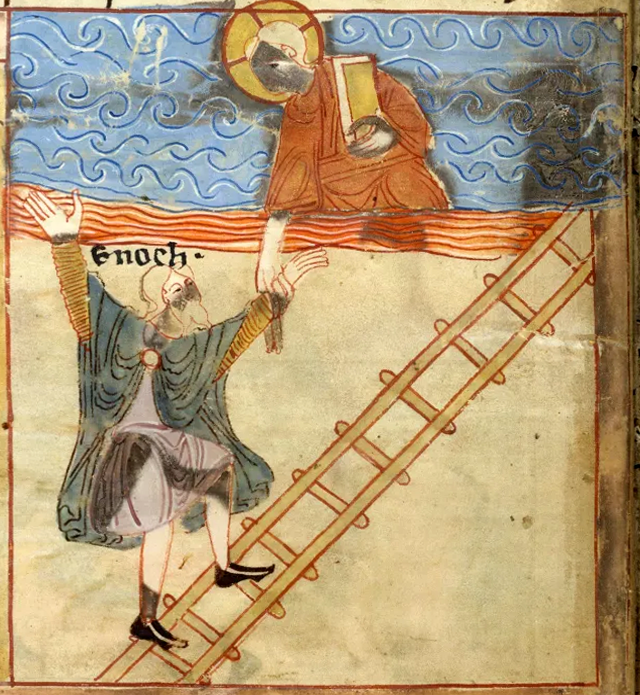
Verticality and alignment
To claim inheritance from an Enochic tradition cannot remain a mere formula. If this reference is invoked, it carries a responsibility: that of understanding what it truly signifies. Without such understanding, the word becomes decorative. With it, it becomes demanding. It compels reflection on transmission, on the place of knowledge, and on the way a symbol crosses time without losing its orientation.
If Masonic tradition associates Enoch with the idea of a preserved deposit, one must ask what this symbol truly means. It does not refer to a spectacular secret, nor to knowledge reserved for a select few out of a taste for mystery. The deposit is not an exotic content; it represents a principle. It symbolizes the permanence of an orientation, fidelity to a truth that does not depend on fashions or circumstances. In this sense, Enoch is not primarily the holder of a treasure: he is the guardian of a rightness.
Yet such rightness does not arise spontaneously. In the ancient narratives, Enoch receives because he is aligned. He walks with God before he is elevated. He is attuned before he becomes a custodian. This sequence is decisive. It suggests that authentic knowledge presupposes an inner transformation of the one who seeks it. Initiatory tradition does not function as a transfer of information, but as a maturation: reception follows alignment. Nothing is imposed from outside; the human being becomes capable of receiving what would otherwise remain invisible.
If the Enochic tradition has endured across the centuries, it may not be only because of the power of its imagery. It may also be because it responds to a persistent tension within human existence: the risk of horizontality.
Horizontality is dispersion, the endless succession of events, the surface of things. Today it takes new forms: the constant flow of information, the accumulation of instant opinions, a perpetual agitation that gives the illusion of depth while never leaving the surface.
Enoch’s ascent, however one chooses to read it, introduces another dimension. It suggests that the human being is not reducible to what lies spread out before him. It affirms that there is depth to be explored, height to be sought—not in order to flee the world, but to understand it differently.
In this sense, the Enochic tradition does not speak of escape. It speaks of orientation.
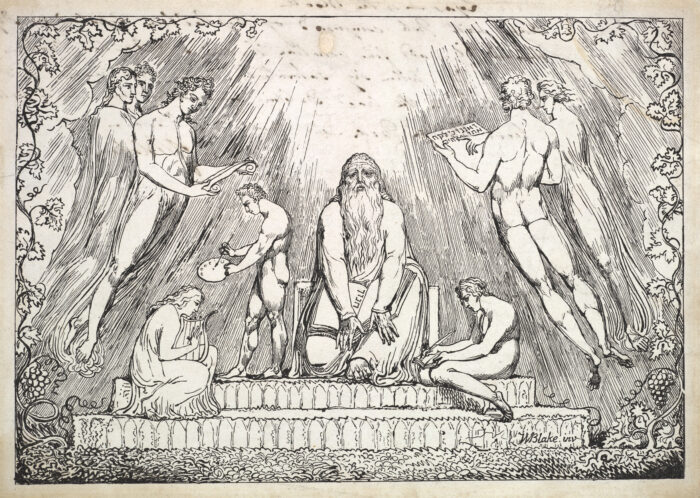
Conclusion
Returning to Enoch does not mean dreaming of a man who would cease to be human. Ancient texts sometimes describe his elevation in grand terms, yet what remains constant is not the spectacle of the narrative. It is the idea of an inner orientation.
Enoch is the one who walks. The one who remains inwardly aligned. The one who receives revelation without turning it into power. The Enochic tradition, across its centuries of development, does not recount the story of extraterrestrials visiting the earth or of lost technological secrets. It has never spoken of inhabited stars or vanished civilizations. Such modern readings reveal more about our contemporary imagination than about the texts themselves.
The Enochic writings speak of something simpler and more demanding: the human relationship to the divine, the awareness of evil, responsibility, transmission. They question the place of the human being within an ordered cosmos and the possibility of inner deepening. The images are powerful, at times vertiginous, yet their aim is not fantastical. It is spiritual in the most sober sense of the word.
When Freemasonry recognizes itself in this figure, it does not claim a spectacular mysticism. It recalls that its work implies a vertical dimension—not in order to flee the world, but to inhabit it with greater lucidity and rectitude.
The Enochic tradition is not an invitation to imaginative excess. It is a reminder. A reminder that a human being can orient his life toward what transcends him without ceasing to be fully human. A reminder that depth exists, even when noise seeks to obscure it.
From an almost silent sentence was born a tradition that has crossed the centuries. It does not speak of fantastical elsewhere. It speaks of us: of our capacity to stand upright, to seek higher than ourselves without losing our footing, to transmit what is worthy of being transmitted.
In this sense, Enoch is not an enigma for dreamers. He is a question addressed to the conscience—and to the way each person chooses to orient his life.
To go further
- François Martin, The Book of Enoch (1906) – translation of the Ethiopian text (public domain).
- George W. E. Nickelsburg & James C. VanderKam, 1 Enoch: The Hermeneia Translation (Fortress Press, 2012).
- André Vaillant, The Book of the Secrets of Enoch – critical edition of the Slavonic text with French translation
- Charles Mopsik (trans.), The Hebrew Book d’Hénoch (Éditions Verdier)
- Philip S. Alexander, “3 Enoch”, in The Old Testament Pseudepigrapha (Doubleday)
The above references are provided for informational and cultural purposes only. There is no commercial relationship with the authors, publishers, or platforms mentioned; these links are not advertisements, but rather further reading intended to provide more in-depth information on the subject matter.
Where possible, the images used to illustrate these articles are systematically accompanied by a reference to their source and credits. Where no source is indicated, this is because the information was not available. These images are used solely for illustrative purposes, in a non-profit context, without any commercial intent or appropriation of the work.