
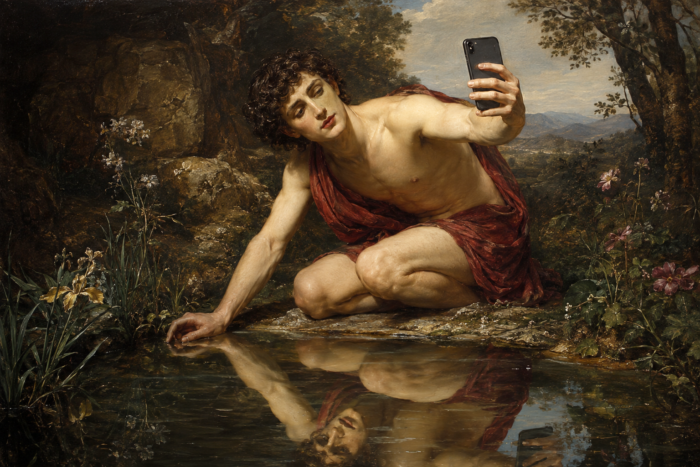
When Reflection Replaces Self-Knowledge
Narcissus would probably have loved Instagram. Assuming, of course, that he could have torn his eyes away from his own profile long enough to look at anyone else’s.
The joke practically writes itself. Perhaps a little too easily.
Ever since mobile phones acquired front-facing cameras and we started photographing ourselves at arm’s length, poor Narcissus has been everywhere. Selfies, Instagram, influencers, the quest for likes, the cult of appearance: Ovid’s young man has been called upon so often to explain our times that he could probably claim royalties.
The comparison is hardly new. Psychologists and researchers have already asked what, if anything, is narcissistic about our digital self-portraits. Some contemporary authors have explored the links between selfies, social media and personality traits; others have challenged such an easy equation. We will come back to this. In other words, inviting Narcissus onto our social networks is nothing new.
In Ovid’s account, Narcissus does not lean over the water thinking, “How handsome I am.” At first, he gazes at a face without knowing that it is his own. He desires the image and tries to reach it. By the time he finally understands what he is looking at, the reflection already has him in its grip. And that is where the story becomes much more interesting.
Perhaps our problem is not that we love ourselves too much. It may have more to do with the considerable amount of energy we spend creating our reflection: choosing the photograph, taking it again, cropping it, filtering it, posting it, then coming back to see what everyone else thought. Narcissus’s mirror had at least one advantage over our screens: it didn’t count likes.
What are we looking for when we look at our own image? To see ourselves, recognise ourselves, reassure ourselves? To guess what others see when they look at us? Perhaps, above all, we are asking the reflection to answer a question that no image can ever truly resolve: who am I?
That is the thread this article will follow. It will take us from Ovid to Freud, from Lacan’s mirror to Snow White’s, from the selfie to Dorian Gray, with a detour through Dracula, who at least has the advantage of being spared this particular problem.
Mirrors have long had a reputation for opening doors, so they will also lead us towards an older conception of reflection: the correspondence between the visible and the invisible, between what is above and what is below.
For there is more than one way to stand before a mirror.
The Ancient Sources and the Different Versions of the Myth
Before talking about narcissism, let us return to Narcissus. Antiquity did not leave us a single version of the myth.
The most familiar account is found in Book III of Ovid’s Metamorphoses. It is neither the only version, nor necessarily the oldest. Other traditions circulated, sometimes different enough to profoundly alter the meaning of the story.
In Ovid, Narcissus is born from the union of the nymph Liriope and the river god Cephissus. His mother consults Tiresias to find out whether her son will live a long life. The seer’s answer is remarkably brief: he will live long, “if he does not know himself” — si se non noverit.
The words are surprising, almost provocative. A long tradition of Western philosophy has made self-knowledge a fundamental requirement. At Delphi, the famous gnōthi seauton urged man to “know thyself.” Narcissus seems to receive precisely the opposite advice: he will survive as long as he remains ignorant of who he is. The entire story is haunted by this paradox.
Narcissus grows into an exceptionally beautiful young man. Men and women desire him, but he rejects them all. Ovid places less emphasis on self-love than on this inability to respond to the desire of another. Among those he rejects is Echo, to whom we shall return, because her story is inseparable from that of Narcissus.
Then comes the punishment. Following a plea to the gods from one of those he has rejected, Nemesis intervenes: Narcissus, too, must experience a desire he cannot satisfy. He comes upon a clear spring, bends over the water and sees a face.
This is usually where our modern Narcissus begins to appear: a young man so much in love with himself that he cannot tear himself away from his reflection.
Yet Ovid tells us something subtler. At first, Narcissus does not know that he is looking at himself. He sees another: eyes, hair, a face, a mouth. He tries to touch the person he believes he has encountered. When his lips approach the water, the image seems to come towards him; as soon as he tries to grasp it, it vanishes. His first reaction, then, is not: “How handsome I am.” It is closer to: “Who is this being I desire?”
Then comes the moment of recognition. Narcissus finally understands: Iste ego sum — “I am he.” He discovers that the person he is trying to reach has no existence independent of his own.
Far from setting him free, this discovery does the opposite. Perhaps this is where the trap finally closes: Narcissus at last recognises himself, yet remains captive to the image. He knows what the reflection is; he still cannot look away.
Tiresias’s prophecy now takes on its full meaning. Si se non noverit. Narcissus has finally recognised himself, in the most literal sense of the word, and that recognition marks the beginning of his downfall.
Other ancient traditions give the myth a different complexion. In the account attributed to Conon, Narcissus rejects, among others, a young man named Ameinias. He even sends him a sword, as a particularly elegant way of letting him know that his feelings are not reciprocated. Ameinias then kills himself at Narcissus’s door, calling upon the gods to avenge him. What follows likewise leads Narcissus to his own reflection and to his death.
Here, the mirror is directly connected with the rejection of another and with vengeance. Narcissus is not simply the victim of his beauty: he is also paying the price for his indifference.
A Greek fragment discovered on papyrus, now known as P.Oxy. 4711, also bears witness to an ancient tradition surrounding Narcissus. Its dating and attribution have been debated by specialists, which calls for some caution. For our purposes, one point is enough: the myth circulated in several forms, and Ovid did not simply set down in writing a perfectly stable story that everyone had always told in the same way.
Pausanias, writing in the second century AD, goes even further. He records another version in which Narcissus had a twin sister who looked almost exactly like him. After her death, Narcissus supposedly took to gazing at his own reflection in the water because he could see in it the features of his lost sister.
This time, he knows that the image is his own. And yet, through himself, he is looking at someone else. The mirror is no longer a romantic trap, but a memory. Almost a liquid tomb.
This is why Narcissus cannot be reduced to excessive self-love. The ancient texts are richer than our modern representations of them: they show us a man who rejects others, mistakes an image for reality, recognises himself without being able to tear himself away from what he sees and, in some versions, searches his own face for the memory of someone else.
Before becoming a psychological concept, then, Narcissus is a question. What do we see when we look at our own image? And are we certain we know whom we are looking at?
Echo, the Other We No Longer See
In Ovid, Narcissus is not alone. Before the mirror, there is the nymph Echo. Condemned never again to speak in her own name, she can only repeat the last words she hears. She still has a voice, but no longer quite has speech of her own: she responds, but she can never begin.
When she sees Narcissus, she falls in love with him. But how can you declare your desire when you can only repeat another person’s words? Ovid constructs an almost cruel scene: Echo tries to turn Narcissus’s words into a declaration of love, to create an encounter out of fragments that do not belong to her.
Narcissus rejects her. Echo withdraws, wastes away and gradually disappears. Soon, all that remains of her is her voice.
The correspondence is striking. Echo becomes a voice without a body; Narcissus will fall in love with an image without substance. One can speak only through another; the other comes to desire nothing but an apparition that reproduces himself. Their story is also the story of an encounter that has become impossible.
Here the myth goes beyond the story of a young man fascinated by his own beauty. Narcissus does not merely suffer from an excess of self-love. Above all, he seems incapable of stepping outside himself to truly encounter another person.
Echo is there. She loves him. She tries to speak to him. But he does not see her. Later, at the water’s edge, he will finally see someone who attracts him irresistibly. That someone will be himself. There is a terrible irony here: the real other is rejected, while the image of the self becomes impossible to leave behind.
Narcissus’s question is not simply: “Do I love myself too much?” It also becomes: what remains of the other when all I seek in them is an echo of myself?
From Myth to Narcissism: Philosophy, Psychology and Psychoanalysis
After centuries of commentary, Narcissus eventually left the banks of his spring and entered the vocabulary of psychology.
The transition did not happen overnight. By the end of the nineteenth century, the name of Narcissus was beginning to be used to describe certain forms of self-centred behaviour. Havelock Ellis invoked the figure in 1898; the following year, the psychiatrist Paul Näcke used the German term Narzissmus. Freud would then give the word an entirely new significance.
In 1914, in On Narcissism: An Introduction, Freud was no longer simply describing an individual excessively in love with himself. Narcissism became part of psychic life itself. To put it very simply, Freud considered that a portion of our libidinal energy could be invested either in others or in ourselves. Narcissism was therefore no longer merely some spectacular abnormality: in certain forms, it played a part in the very construction of the self.
This was a considerable shift: Narcissus was no longer simply the man who looked at himself too much; he now provided a way of understanding how an individual can become an object to himself.
Psychoanalysis would subsequently develop the concept in many, sometimes very different, directions. There is no need to venture into all its schools and disputes here. Psychoanalysis has already amply demonstrated its ability to produce mirrors of its own.
A brief detour through Lacan, however, is directly relevant to us. In his work on the “mirror stage,” Lacan describes the moment when a young child recognises its image in a mirror. This recognition plays a part in the formation of the ego. The child apprehends itself through an external, unified image, even though its inner experience is still far less ordered.
The parallel with Narcissus is tempting, but the two should not be confused. Lacan is not offering a new interpretation of the myth. The mirror allows him to think about the formation of the ego through a representation of the self. The mirror no longer simply reflects a face; it becomes part of the way we represent ourselves.
We do not merely have an identity; we also construct an image of it. That distinction becomes crucial the moment the bathroom mirror gives way to the mirror of social media.
In everyday language, the word “narcissistic” has become considerably simpler. It is readily used to describe someone who is vain, self-centred, obsessed with their appearance or excessively preoccupied with themselves. Clinical term, psychoanalytic concept and bar-room insult all get cheerfully mixed together.
But let us not confuse everything.
Posting selfies does not automatically turn someone into Narcissus. Nor does caring about one’s appearance. Using social media is obviously not a psychological diagnosis. The interesting question is this: what happens when our self-image becomes not merely something we look at, but something we manufacture, publish and correct — and then wait for others to tell us what it is worth?
Narcissus in the Age of the Selfie
Narcissus’s problem required very little: a spring, a reflection and plenty of time. Since then, we have considerably refined the system.
The mirror now fits in our pocket. And it can do what the spring could not: preserve the image, alter it, and then show it to others.
There is nothing particularly extraordinary about the selfie itself. Human beings have been making images of themselves for a very long time. What is new is not the desire to have an image of ourselves, but the ease with which we can produce one and, above all, choose it.
A selfie is almost never simply an instantaneous reflection. We frame the shot, take it again, choose the lighting, discard the photo where our eyes are closed. We construct an image of ourselves; we select what we show. We post the holiday, rarely the wait at the airport; the dinner with friends, much less often the washing-up afterwards.
This is not necessarily a matter of lying. Rather, we compose an edited version of ourselves, a kind of permanent trailer for our lives, with certain scenes left on the cutting-room floor.
The great modern change may not be the mirror itself, but the audience gathered around it. Narcissus had a reflection. We have a reflection, spectators and a like counter.
The image we post comes back to us accompanied by information: how many people saw it, liked it, commented on it, shared it? The gaze of others, which has always played a part in constructing our social identity, becomes measurable. We did not wait for Instagram to start caring about our reputation, but it is now possible to turn part of that recognition into numbers — and numbers have a formidable appearance of objectivity.
A subtle mechanism can then take hold: little by little, we learn which images of ourselves people like. The reflection begins to answer back.
Yet the gaze of another person can be understood very differently. The other is not a mirror. They can surprise us, contradict us, love us, reject us, reveal what we cannot see. The problem begins precisely when we ask them to become our mirror.
Research into social media, selfies and narcissism has, moreover, produced results far less straightforward than some alarmist accounts would suggest. In 2018, Seunga Venus Jin and Ehri Ryu studied 398 Instagram users in “The Paradox of Narcissus and Echo in the Instagram Pond,” examining the relationships between narcissism, self-confidence, the need for popularity, loneliness, selfies posted and number of followers. There are connections, but the picture cannot be reduced to “lots of selfies = lots of narcissism.” Jessica Maddox, in “Guns Don’t Kill People… Selfies Do” (2017), likewise criticises the overly convenient use of the Narcissus myth to explain selfie culture and suggests looking instead towards self-exhibition, since the selfie, unlike Narcissus’s reflection, is made to be shared.
Posting a lot of selfies therefore tells us very little in diagnostic terms. Fortunately, a few Instagram accounts are not yet a substitute for several years of studying psychology.
What is more interesting is the system within which we learn to represent ourselves. We choose an image, post it, then return to observe the reactions. I look at myself while trying to imagine how you are looking at me.
And this phenomenon is no longer confined to our faces. We display our travels, our meals, our opinions, our successes, our anger, our children, our love stories and sometimes our break-ups. The contrast with the old private diary remains striking. Not every personal diary of the past was intended to remain secret, of course, but its symbolic image remains: diaries were readily kept closed because they contained what we did not want to show. Social media often operates according to an almost opposite logic: open up, post, be seen.
A photograph or a publicly shared emotion may be perfectly sincere. Their accumulation does not necessarily produce self-knowledge. What it produces first is an image.
Our age does not condemn us to the fate of Narcissus. It does, however, raise a question he would have understood better than anyone: how did we move from “know thyself” to “show thyself”?
The Mirror, a Boundary Between Two Worlds
A mirror is a much stranger object than it appears. We use it every day with such familiarity that we almost forget what it actually does: it opens before us a space that does not exist. The room seems to continue beyond the glass. Depth appears where there is only a surface. Everything is recognisable, yet everything is reversed.
The mirror reproduces the world without ever being the world. It gives us a double of it. And that is no doubt why it has so often been associated with the uncanny, with secrecy, passage and the invisible.
In the world of Snow White, the mirror performs yet another function: it becomes a judge. The famous “Mirror, mirror on the wall…”, as popular culture remembers it, does not ask the reflection to reveal some inner truth. It asks it to name the fairest of them all. The mirror becomes an external arbiter of value.
Gounod also plays with this delight in one’s own image in the Jewel Song from Faust. Marguerite marvels: “Ah! I laugh to see myself so beautiful…” The scene became more familiar still to several generations through Tintin’s Bianca Castafiore, for whom this enthusiastic contemplation of herself became almost second nature.
Between Snow White’s queen demanding a ranking from her mirror and Castafiore joyfully celebrating what she finds in hers, the mirror clearly knows how to flatter as well. Which, when you think about it, already makes it somewhat similar to some of our screens.
Lewis Carroll made the mirror the very principle of Through the Looking-Glass. Alice no longer merely observes her reflection: she passes through the surface. The gesture seems almost natural. After all, a mirror gives precisely the impression that another space begins behind it. In Carroll, that space becomes an entire world, close to our own yet governed by a different logic, as though the reflection had ceased to obey its model. The mirror no longer merely copies reality; it opens onto another possibility of reality.
Jean Cocteau goes further still. In Testament of Orpheus, mirrors become passages to the beyond. They no longer serve to return an image, but to cross a boundary. The idea is particularly beautiful: we generally stand before a mirror to check what is visible. Cocteau asks us what might lie behind it.
And sometimes it is precisely the absence of an image that reveals something.
In Dracula, Bram Stoker uses the mirror in almost the opposite way. Jonathan Harker is disturbed to discover that the Count casts no reflection. This time, the mirror does not show what is there; it shows what is missing. And that absence becomes evidence. Narcissus is lost because he encounters his reflection; Dracula reveals his true nature because he has none.
Oscar Wilde shifts the question again. In The Picture of Dorian Gray, there is no mirror in the strict sense. But the portrait performs a very similar function. Dorian’s actual face retains its youth and seductive appearance, while the painted image gradually bears the marks of what he is becoming.
The image now tells what the face conceals. It becomes more truthful than the person it represents. We are a long way from the carefully selected selfie, yet the problem remains surprisingly close: what happens when image and reality cease to coincide?
In one case, we alter the image to make it correspond more closely to what we want to show. In the other, the image reveals precisely what we would rather conceal. The mirror, then, can flatter, deceive, reverse, reveal, open a passage or show an absence.
It can reassure us. It can also disturb us. And perhaps because it resembles us without ever being us, it always retains something ambiguous.
When Narcissus looks into the water, at first he believes he sees another. When Alice looks into the mirror, she imagines another world. When Dracula passes before one, he discovers, despite himself, that he no longer quite belongs to ours. And when Dorian contemplates his portrait, he sees emerging what his own face no longer wishes to reveal.
So we return to our original question, but it has shifted. When we look at our reflection, are we simply seeking an appearance, reassurance, a double? Or something that might lie behind the image?
Narcissus and Initiation: From Reflection to Self-Knowledge
From the beginning, the same phrase has been running quietly through this article: “know thyself.” The famous gnōthi seauton belongs neither to modern psychology nor to Freemasonry; associated in Greek antiquity with the sanctuary at Delphi, it has echoed throughout the history of Western philosophy.
But what does it mean to “know oneself”? To know our face, our character, our tastes, our flaws, the image others have of us? A little of all these things, no doubt. But not only that.
Here lies the whole paradox of Narcissus. At last he recognises his own face and understands that the fascinating being before him is himself, yet this discovery does not set him free. He recognises himself; he does not know himself. Si se non noverit, once again.
To recognise is to identify an image. To know oneself means looking at what is less easily grasped: contradictions, fears, desires, illusions, the reasons we acknowledge and the motives we would rather leave in the shadows.
A mirror shows us what is visible. It does not tell us why certain words hurt us, why we repeat the same mistakes, or why we sometimes seek so insistently the approval of people we claim not to want to impress. On that ground, even the finest mirror in the world quickly becomes useless — and a beauty filter on our apps even more so.
This is not about dismissing the image. We all have a social face, several ways of presenting ourselves to the world. The problem begins when that representation claims to define what we are. There is a profound difference between managing our image and working on ourselves.
The other becomes essential precisely because they are not our mirror. Echo has already shown us this: Narcissus rejects the encounter with what is not himself. Another person can contradict us, surprise us, notice what we thought we had hidden and crack the image we have chosen. To know ourselves through another does not mean asking them for confirmation.
Why not take the question all the way back to the story of creation itself, and to the idea of human free will? Some theories of emanation develop a beautiful idea: that the Divine brought forth from itself not a reflection, but another, autonomous reality, so that it might discover itself in the eyes of the other.
Here the question takes on an initiatory dimension. An initiatory path is not simply about accumulating knowledge; it also transforms the way we look at ourselves. Neither admiring ourselves nor taking a daily inventory of our shortcomings: the aim is to learn to see more clearly.
This is no doubt one reason why Freemasonry, like other initiatory traditions, places such importance on work on oneself. Not because it possesses a definitive answer to the question “Who am I?” — that would be rather paradoxical — but because it offers a framework in which the question can be asked differently, by confronting the image we have constructed of ourselves with our actions, our words, other people and what we are seeking to become.
The initiatory path may begin at the very moment when the reflection ceases to be an answer and becomes the beginning of a question.
From Reflection to Correspondence — The Mirror in Hermetic Traditions
Until now, we have looked at the mirror through the eyes of Narcissus. Yet we can question it differently: no longer simply “What does it show me?” but “What is what I see a reflection of?”
This question takes us into territory familiar to Hermetic traditions. There, the visible world can be understood not as an isolated reality closed in upon itself, but as the manifestation of an order that transcends it. The famous Emerald Tablet expresses this in a formula that would echo through centuries of Hermetic literature: “that which is below corresponds to that which is above, and that which is above to that which is below.”
This is not a physical mirror, but a correspondence, a projection. Two levels of reality answer one another; the visible points towards the invisible, manifestation towards its principle. The world thus becomes something that can be read.
The difference from Narcissus is fundamental. He contemplates the reflection and stops there. Hermetic thought contemplates it in order to trace it back to that from which it proceeds. Here, the image captivates; there, it points beyond itself. It is no longer an end, but a sign.
The relationship between the celestial and the terrestrial, between principle and manifestation, reappears in various forms across many philosophical and esoteric systems. It would be unwise to gather them all under a single doctrine. They nevertheless share an intuition: what we perceive does not necessarily exhaust what is.
This idea naturally finds an echo in symbolic language. The earthly world is not conceived as separate from the principle that transcends it, but as the place of its manifestation. The symbol thus establishes a relationship and invites us to move from what is shown to what is signified.
Nor does this question belong exclusively to Western traditions. A remarkable episode from the Chāndogya Upaniṣad in India brings us almost directly back before Narcissus’s mirror. Indra and Virocana come to receive a teaching about the Self. They are asked to look at their reflections in water. Virocana leaves satisfied; Indra, however, has doubts. If the body changes, suffers or disappears, the image changes, suffers or disappears with it. The reflection clearly shows something of us — but does it show what we are?
Without conflating two very different cultural worlds, Narcissus and this Indian episode confront us with a remarkably similar question. Narcissus eventually says: “That being is me.” Indra, by contrast, begins to reflect at the precise moment when he understands that the image is not enough to answer the question of the Self.
An image is not necessarily false. Narcissus’s reflection is not false, nor is Indra’s, any more than our profile picture is. An image can be faithful and still remain incomplete. The error begins when we demand more of it than it can show.
Behind the filters, profiles, avatars and carefully chosen photographs remains a question far older than social media: is what I see reality, or merely the way reality appears to me?
Hermetic thought does not ask us to reject appearances, but to pass through them. The visible also derives its value from what lies beyond it. The reflection, then, is not the enemy. The danger would be forgetting that it is only a reflection.
Conclusion — Beyond the Mirror
This reflection began by suggesting that Narcissus would probably have loved Instagram. The joke already looks a little different.
Narcissus’s problem, in the end, was not that he took too many photographs of himself, sought other people’s approval or overused beauty filters. His misfortune was much simpler: he encountered an image and could no longer tear himself away from it.
Our mirrors have changed. They have become screens, profiles, photographs and avatars. They can be edited, shared, commented on and counted. But they remain surfaces.
Perhaps we sometimes forget this obvious fact. An image can represent us. It can flatter us, betray us, reassure us, even reveal something about ourselves that we had not seen. But it cannot live in our place.
When the mirror ceases to be a destination, it can become again what it should always have remained: a passage.
Our social networks show us an idealised image of ourselves. But what awaits us on the other side of the reflection is not a more perfect image of ourselves. What awaits us is something far more difficult, uncertain and precious: ourselves, still to be discovered. Si se non noverit.
To go further
- Ovide, Les Métamorphoses, Livre III — Écho et Narcisse — le récit classique au cœur de l’article : la prophétie de Tirésias, Écho et la fascination de Narcisse pour son reflet.
- Sigmund Freud, Pour introduire le narcissisme (1914) — le texte fondateur dans lequel Freud fait du narcissisme un élément de la vie psychique et non plus seulement un amour excessif de soi.
- Seunga Venus Jin et Ehri Ryu, « The Paradox of Narcissus and Echo in the Instagram Pond » (Journal of Broadcasting & Electronic Media, 2018) — une étude menée auprès de 398 utilisateurs d’Instagram sur les relations entre narcissisme, estime de soi, solitude, selfies et popularité sur les réseaux sociaux.
- Jessica Maddox, « Guns Don’t Kill People… Selfies Do » (Critical Studies in Media Communication, 2017) — une critique intéressante de l’association trop rapide entre le mythe de Narcisse, le narcissisme et la culture du selfie.
- La Chāndogya Upaniṣad — pour prolonger la réflexion sur le Soi, notamment l’enseignement d’Indra et Virocana autour du reflet et de l’identification du Soi au corps.
The above references are provided for informational and cultural purposes only. There is no commercial relationship with the authors, publishers, or platforms mentioned; these links are not advertisements, but rather further reading intended to provide more in-depth information on the subject matter.
Where possible, the images used to illustrate these articles are systematically accompanied by a reference to their source and credits. Where no source is indicated, this is because the information was not available. These images are used solely for illustrative purposes, in a non-profit context, without any commercial intent or appropriation of the work.