
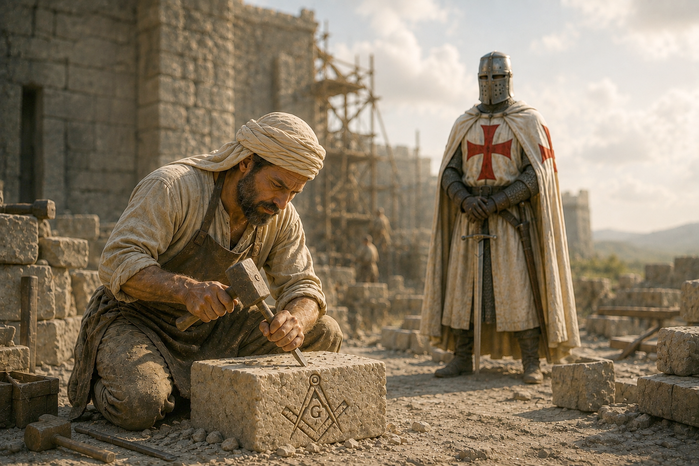
Between History, Tradition and Legend
Templars and Freemasons: the connection may seem surprising to those who know little about Freemasonry. Yet the association is by no means artificial.
Since the eighteenth century, several Masonic traditions have incorporated forms of Templar-inspired chivalry into their initiatic systems. The Templar Strict Observance, the Rectified Scottish Rite, the Masonic Knights Templar of the English-speaking world, and certain high degrees of the Ancient and Accepted Scottish Rite all bear witness to this.
There is, then, a genuine memory of the Temple within Freemasonry. But what does that memory actually mean? For nearly three centuries, historians, researchers and Freemasons have compared documents, traditions and legends in an attempt to determine whether this Templar presence reflects a genuine historical lineage.
We will not attempt to settle that controversy here. Our approach will be different. We will begin with what history allows us to establish. We will examine what actually survived the suppression of the Order, what the documentary record can demonstrate, but also the areas of uncertainty around which so many traditions have developed.
Gradually, however, another question will emerge. Why has the figure of the Templar exerted — and why does it continue to exert — such a powerful fascination within Freemasonry? And what are we really seeking when we choose to see ourselves as the heirs to a tradition?
A Story That Refuses to Die
Some stories seem unwilling ever to disappear. The story of the Templars is one of them.
The Order of the Temple was suppressed at the beginning of the fourteenth century. Jacques de Molay was burned at the stake in 1314. The surviving brethren met very different fates, the Order’s property changed hands, and its official structures disappeared.
The story might have ended there. Yet it did not. For centuries, the same question has returned again and again: did the Templars truly disappear? The answer, of course, depends on what we mean by “disappear.”
The men themselves did not all vanish with the Order. The buildings remained. Lands, commanderies and other properties were taken over, redistributed or transformed. Part of this history can still be traced through the archives.
But another question is far more difficult. Did something immaterial survive as well? A tradition, a body of knowledge, certain rites? A particular understanding of chivalry? Perhaps even the famous “Templar secret” around which so many narratives have been constructed?
This is where the historical picture becomes less certain. Between the official disappearance of the Order of the Temple and the emergence, several centuries later, of Masonic traditions claiming its heritage, there lies an immense gap.
It is within that gap that the hypotheses begin to appear. Some look for the Templars in Scotland. Others imagine discreet lines of transmission through various spiritual or initiatic currents. Others still seek traces of teachings supposedly brought back from the East.
These possibilities deserve to be examined. But they must be considered in the right order. Before asking what might have been secretly transmitted over several centuries, we should begin with a much simpler question: what actually became of the Templars after the disappearance of their Order?
After 1312: What Actually Survived
When Pope Clement V suppressed the Order of the Temple in 1312, not everything disappeared with it. The Templars were men, but the Order also possessed lands, commanderies, churches, fortifications, revenues, and an extensive material network built up over nearly two centuries.
Most of these properties were transferred to the Order of the Hospital of Saint John of Jerusalem, the future Order of Malta. But this redistribution was neither immediate nor uniform. Depending on the kingdom, the political situation and local interests, former Templar possessions followed different paths.
In Portugal, King Denis I refused to allow the Templar organisation in his kingdom to disappear entirely. In 1319, with the approval of Pope John XXII, he established the Order of Christ. Some former Portuguese Templars, together with part of their possessions, thus found a form of institutional continuity within the new Order.
In the Crown of Aragon, a comparable solution had emerged a few years earlier with the creation of the Order of Montesa, to which some former Templar and Hospitaller properties were transferred. These continuities matter. They show that the suppression of the Order did not bring about the immediate disappearance of everyone who had belonged to it, nor of everything it had possessed. But they do not, in themselves, prove the clandestine survival of the Order of the Temple.
Scotland presents a more enigmatic case. At the time of the Templar trials, Robert the Bruce was at war with England and under excommunication. According to legend, Templars found refuge with him and took part in the Battle of Bannockburn in 1314.
The image is a powerful one: outlawed knights escaping persecution, joining a king who was himself at odds with Rome, and helping to secure a decisive victory over the English. It has profoundly shaped the Scottish Templar imagination. Yet contemporary sources do not establish the presence of an organised Templar contingent at Bannockburn.
This does not mean that no former Templar could have made his way to Scotland. It simply means that we do not possess the documentary evidence required to turn that possibility into an established historical fact.
At this stage, then, we can distinguish between two things. The survival of individuals and property is a historical reality. The survival of an organised, clandestine Templar Order is another question altogether. And it is precisely within that gap that one of the most fascinating ideas in this entire story begins to emerge: the idea that a secret, at least, may have survived.
Did a Secret Survive?
Once we accept that individuals, property and certain structures survived the suppression of the Order, another question arises.
Was something more discreet also transmitted? A reserved teaching or doctrine? The Templars, of course, had their own internal customs. Like any religious order, they lived according to a rule, had ceremonies, practices of admission, and a highly codified organisation.
But this is not enough to establish the existence of a secret esoteric teaching. The trials of the early fourteenth century contributed greatly to this idea. The Templars were accused of strange practices, of denying Christ, of obscene gestures, of idolatry, and even, in some accounts, of worshipping a mysterious head. Some of the depositions are spectacular. They must nevertheless be treated with considerable caution.
Some confessions were obtained under exceptionally harsh conditions of interrogation, sometimes under torture or the threat of it. Testimonies contradict one another. Several brethren later retracted their statements. And the accusations themselves formed part of a political and religious trial whose stakes extended far beyond the question of the Order’s internal practices.
This does not mean that we know everything about the life of the Templars. Clearly, we do not know it in every detail. But to date, no clearly identified medieval corpus provides us with a Templar esoteric doctrine comparable to what would later be described as a secret initiatic tradition. We possess no text from the Order setting out a specifically Templar gnosis or a mysterious body of teaching reserved for the knights and transmitted from master to disciple.
Yet this is precisely what later centuries would gradually come to imagine.
The East plays an essential role here. The Templars did indeed come into contact with the Nizari Ismailis, long known in the West as the “Assassins”. They fought them, negotiated with them, and maintained political relations that were at times highly complex. Tributes were paid. The contact between them is therefore historically established.
An initiatic transmission, however, is not documented in the same way. We possess no medieval text that would allow us to claim that the Nizaris transmitted rites, an esoteric doctrine, or secret teachings to the Templars.
The hypothesis is certainly appealing: two hierarchical organisations, operating in the same territories and surrounded by mystery, might naturally have exchanged more than political agreements. It is possible to imagine. That is not the same as being able to demonstrate it.
Gradually, other elements would become attached to this narrative.
First, the Temple of Solomon. The very name of the Order naturally invites comparison with Freemasonry, which has made Solomon’s Temple one of its central symbolic images. Then come the Grail, gnosis, alchemy, and various Eastern traditions. Each of these worlds has its own distinct history. Yet over time they would converge within a shared Templar imaginary.
The Templar thus becomes more than a medieval warrior monk. He becomes the supposed custodian of ancient knowledge. And it is at this point that the question truly changes. It is no longer simply a matter of asking whether some Templars survived after 1312. We must now ask by what paths the idea of Templar survival may have travelled across the centuries and, above all, where its traces can actually be found.
For between the medieval Temple and the first explicitly Templar Masonic traditions, there still remains an immense historical gap to explore.
Four Centuries of Silence
Nearly four centuries separate the suppression of the Order of the Temple in 1312 from the emergence, in the eighteenth century, of Masonic traditions explicitly claiming a Templar heritage. Four centuries during which the thread becomes increasingly difficult to trace.
One possible path leads towards the Rosicrucians. In the early seventeenth century, the Rosicrucian manifestos appeared. They described a secret fraternity entrusted with an ancient wisdom, quietly working towards the spiritual and intellectual transformation of the world. The connection with a possible Templar survival would be made only later.
Here again, we encounter a world in which clandestine transmission seems conceivable: a discreet fraternity, reserved knowledge, initiation, a chain of transmission. Yet no document allows us to trace the passage of a medieval Templar group into the earliest Rosicrucian circles of the seventeenth century.
Stuart and Jacobite circles offer another possible avenue. Exile, political loyalties, aristocratic networks and fraternal societies created, throughout the seventeenth and eighteenth centuries, an environment in which men, ideas and traditions circulated across borders. Several later claims of Templar lineage would place part of their transmission precisely within these networks.
This is where the situation becomes intriguing. The individual elements are there. We find Scottish traditions that would indeed associate Freemasonry with chivalry. We find fraternities presenting themselves as custodians of a secret wisdom. We find political and aristocratic networks capable of carrying men and ideas across Europe.
What is missing is the evidence that would connect them. Not a resemblance, not a possibility, but an identifiable line of transmission. Between the last medieval Templars and the first clearly documented chivalric Masonic traditions, no known body of sources currently allows us to trace an unbroken chain.
And yet, when we reach the eighteenth century, something changes. What now becomes clearly documented is not the introduction of chivalry into the Masonic tradition: chivalry had been present there much earlier. The novelty lies in the emergence of degrees and systems in which chivalry itself becomes a form of Masonic initiation.
And this time, the documents are there.
When the Templars Truly Meet the Freemasons
We must first reconsider an idea that is often accepted somewhat too readily: chivalry did not suddenly enter the Masonic world in the eighteenth century. It had already been present for much longer in the texts that recount and regulate the history of the Craft.
In the Regius Manuscript, one of the oldest known foundational texts associated with Freemasonry, traditionally dated to around 1390, knights and squires already appear alongside the masters of the Craft. Their presence is not merely decorative. They feature in particular in the account of Athelstan’s assembly, among the authorities gathered to establish and enforce the ordinances of the Craft. Knights even takes part in the reception of Masons.
This presence does not disappear with the Regius. In the Dowland Manuscript, generally dated to around 1550, and subsequently in the Lansdowne Manuscript, dated to around 1560, Saint Alban is explicitly described as a “worthy knight”. He is not simply a figure mentioned in passing: he protects the Masons, improves their wages, obtains from the king and his council a charter allowing them to hold a General Assembly, attends that assembly himself, and takes part in the organisation of the Craft. The same theme appears again in the William Watson Manuscript, dated 1687, where Saint Alban is once more described as a knight, a protector of the Masons, and an active participant in their assembly.
We must consider carefully what this means, without making the documents say more than they actually do. These texts demonstrate no lineage from the Order of the Temple. Nor do they describe a form of chivalric Freemasonry comparable to the systems that would emerge later. But they do show that the world of chivalry was neither foreign to the older Masonic narrative nor something entirely grafted onto it in the eighteenth century. From the Regius, traditionally dated to around 1390, through several of the Old Charges of the sixteenth and seventeenth centuries, knights, authorities of the Craft and Masons already belonged to the same legendary and regulatory history.
The true break in the eighteenth century therefore lies elsewhere. It is not chivalry itself that appears: rather, chivalry becomes a fully-fledged form of Masonic initiation. Explicitly chivalric degrees and systems begin to take shape. In the older narratives, the Mason had been placed under the protection of knights or alongside them; now he could himself be received as a knight.
It is within this development that the Discourse of Chevalier Andrew Michael Ramsay, delivered in 1736 and circulated in a second version in 1737, acquires its full significance. Ramsay does not claim that Freemasons descend directly from the Templars. Instead, he connects Freemasonry with a broader chivalric heritage associated with the Crusades, the Holy Land and the return of the knights to Europe. He therefore does not introduce chivalry into a Masonic world that had previously known nothing of it: he gives it a new dimension. With Ramsay, the Crusades and chivalry become elements in an explanation of the very origins of Freemasonry.
The distinction is essential. The presence of chivalry within the Masonic tradition is old; its transformation into a structured chivalric initiatic path belongs to the eighteenth century. It is from this second stage onward that the specifically Templar question becomes genuinely traceable in the documentary record.
At around the same time, distinctly chivalric Masonic systems begin to be documented in Scotland. The Royal Order of Scotland provides a particularly interesting example. Its existence is documented in London in 1741 and then in Edinburgh in 1750, where the regulations of its Grand Lodge were established. It comprises two degrees, Heredom of Kilwinning and Knight of the Rosy Cross. Its own tradition traces its origins to Robert the Bruce, the Battle of Bannockburn in 1314, and Kilwinning. The surviving documents allow the existence of the Order to be traced with certainty from 1741 onward; the antiquity of the tradition beyond that date remains a separate question.
Other systems practised in Scotland would also include degrees bearing explicitly chivalric or Templar titles, such as Knight Commander of the Temple, Scottish Knight of Saint Andrew, and Knight Kadosh. The association between Scotland, chivalry and the Temple would therefore not remain merely an idea imposed upon Freemasonry from outside: during the eighteenth century, it found expression within Masonic initiatic systems themselves.
In France, the higher degrees developed rapidly during the 1740s and 1750s. Knights, military orders, crosses, and themes of fidelity, trial and restoration began to appear, sometimes accompanied by more direct references to the Temple.
Among the most significant evidence are the 1750 manuscripts relating to the Sublime Order of Elect Knights (Ordre Sublime des Chevaliers Élus), discovered in the archives of Quimper and Poitiers. André Kervella and Philippe Lestienne published and studied them in “Un haut-grade templier dans les milieux jacobites en 1750 : l’Ordre Sublime des Chevaliers Élus aux sources de la Stricte Observance”, published in Renaissance Traditionnelle, no. 112, in 1997. These documents attest to the existence, in mid-eighteenth-century France, of an already structured form of chivalric Freemasonry with a distinctly Templar character. They mention, among others, the Comte de La Tour du Pin and Baron von Vegesack.
In other words, references to the Temple did not suddenly emerge within a single isolated system. They were already circulating through several networks and Masonic constructions. The later development of the Knight Kadosh provides another particularly clear example. Eventually becoming the 30th degree of the Ancient and Accepted Scottish Rite, it belongs unmistakably to this chivalric and Templar world. The figure of Jacques de Molay occupies an explicit place within it.
It is within this already well-prepared environment that Baron Karl Gotthelf von Hund appears. His account is well known. Hund claimed to have received, in Paris around 1742–1743, a chivalric Templar transmission. According to his own narrative, he was received under the authority of mysterious “Unknown Superiors” within a circle of Scottish knights, where a figure appears under the name Eques a Penna Rubra, the “Knight of the Red Feather”, whom Hund would later identify with Charles Edward Stuart. Hund himself bore the name Carolus Eques ab Ense, the “Knight of the Sword”. He subsequently developed what would become the Templar Strict Observance.
He referred to connections with Jacobite and Stuart circles, and several names have been proposed for those who may have taken part in this transmission. The details of the case remain difficult to establish with certainty.
What is certain, however, is that Hund was operating in a context in which chivalric Freemasonry already existed in France and elsewhere. His Templar claim therefore did not arise in a historical vacuum. With the Strict Observance, that claim acquired considerable scope. The system asserted a structured Templar lineage and spread this vision widely throughout European Freemasonry.
Moreover, Karl Gotthelf von Hund was not entirely removed, through his own family history, from the world of chivalric orders. Born in 1722 in Upper Lusatia into an old family of the Silesian nobility, he belonged to the Hund und Altengrotkau lineage. In the early sixteenth century, one of his ancestors, Heinrich von Hund, was a commander of the Order of Saint John of Jerusalem at Glatz, now Kłodzko, where he notably served as burgrave — a military commander — in 1518 and later as governor in 1523–1524.
Why is this detail worth noting? The Order of Saint John of Jerusalem — the future Order of Malta — was precisely the order to which Pope Clement V, through the bull Ad providam of 2 May 1312, transferred the greater part of the property of the Order of the Temple following its suppression. This is one of the most striking historical convergences encountered in this inquiry: the family background of one of the principal founders of eighteenth-century Templar Freemasonry intersects here with the history of a medieval chivalric order that had directly benefited from the transfer of a substantial part of the Templars’ possessions.
This obviously does not constitute proof of a Templar transmission reaching von Hund. But it places his undertaking within a far more tangible family context. When Hund built an eighteenth-century Masonic organisation structured around chivalry and the memory of the Temple, he was not operating solely within a medieval imaginary that was then widely shared. His own family background contained a historically attested chivalric reality: one of his ancestors had held a senior office within one of the great religious and military orders born of the Crusades.
This fact does not establish the Templar lineage claimed by the Strict Observance. It does, however, invite us to reconsider the place that chivalry may have occupied within the personal world of its founder.
The system would subsequently evolve further. During the second half of the eighteenth century, Jean-Baptiste Willermoz took up part of this inheritance and played a major role in the transformation of the Strict Observance into the Rectified Scottish Rite. With the Convent of the Gauls in 1778, followed by the Convent of Wilhelmsbad in 1782, the claim to direct historical descent from the Templars was gradually abandoned. Chivalry, however, remained. It assumed a different form in the Beneficent Knight of the Holy City, incorporating, in particular, Martinesist doctrine.
The shift is significant. The aim is no longer necessarily to demonstrate that Freemasons are the institutional descendants of the Templars. Chivalry is nevertheless retained as an initiatic, moral and spiritual form.
The inability to demonstrate an unbroken institutional lineage does not, however, make the traditions that claim such an inheritance illegitimate. An initiatic tradition is not a genealogical record. It may transmit symbols, narratives, ritual forms and a particular conception of the human being without being able to produce, century by century, a complete documentary chain showing exactly how each element was passed on.
Between “this lineage is historically demonstrated” and “this tradition was invented out of whole cloth” lies a considerable space. It is precisely within that space that many chivalric Masonic traditions are situated. Their historical existence is very real. So too is their symbolic depth. What history cannot always establish is the exact continuity connecting these modern forms with the medieval institutions whose heritage they claim or consciously assume.
The historian can identify this break in the documentary record. But that break alone does not allow the historian to conclude that everything on the other side of it is devoid of meaning, depth or initiatic value. History and tradition therefore do not necessarily contradict one another. They are simply asking different questions.
When Tradition Becomes Legend
The more gaps a story leaves behind, the more it invites narratives capable of filling them. The Order of the Temple is no exception. Its brutal end, the condemnation of its leaders, the silence that followed, and the late reappearance of Templar traditions within Freemasonry created ideal ground for all kinds of reconstruction.
The figure of Jacques de Molay occupies a central place in these narratives. Tradition attributes to him a curse pronounced against Pope Clement V and King Philip the Fair at the moment of his death. The story is famous. It is also late in origin and highly legendary.
Later still came the idea of a vengeance finally accomplished several centuries after his death. At the execution of Louis XVI in 1793, a cry is said to have risen from the crowd: “Jacques de Molay, you are avenged!”
The image is a powerful one. It almost encapsulates an entire narrative by itself: the Templars would have survived in the shadows, their heirs would have endured through the centuries, and in the end they would have taken their revenge on the French monarchy.
From there, it is only a short step to portraying the French Revolution as a Templar or Masonic undertaking. That step has often been taken.
In some versions, the Rosicrucians become the guardians of the secret of the Temple. In others, the Freemasons take on that role. Elsewhere still, several secret traditions are imagined as succeeding one another until they form a single hidden chain running behind the great upheavals of European history.
The mechanism is almost always the same. It begins with real facts. The Temple existed. It was suppressed. Some of its members survived. Chivalry was already present in the foundational narratives of the Craft, and then, in the eighteenth century, explicitly chivalric and Templar Masonic degrees and systems appeared.
Then come the centuries we know less well. And the dots are connected. The resulting narrative can become remarkably coherent. At times, even compelling. But a coherent story is not yet a historical demonstration.
There is one final trap. Faced with the absence of documents, one may be tempted to argue that this very absence proves the secret nature of the transmission.
The reasoning then becomes circular and impossible to test. Every piece of evidence confirms the hypothesis. And the absence of evidence confirms it as well. At that point, we are no longer really dealing with history. We have entered a narrative that nothing can contradict.
None of this diminishes the symbolic power of these legends. They tell us something about our fascination with lost lineages, transmitted secrets, and inheritances that refuse to disappear. But they must be recognised for what they are: narratives built around real events, gradually enriched by the imagination, convictions and needs of those who transmitted them.
The figure of the Templar, moreover, would not remain confined to Freemasonry. In the modern era, numerous organisations have adopted the Templar name, emblems or chivalric ideal, with very different intentions. Some are Christian, charitable, commemorative, or simply attached to a particular conception of chivalry. Others, by contrast, have used the imagery of the Crusades and the Temple in support of identity-based narratives. In certain circles, such appropriations have even intersected with supremacist ideologies.
Here, a clear distinction is necessary: the Templar chivalry found within the Masonic traditions discussed in this article belongs to an entirely different sphere. It is neither nostalgia for the Crusades, nor the expression of an ethnic or national identity, nor a call to struggle against a religion or a people. Its interpretation is initiatic and symbolic: it questions our relationship to the word we give, to duty, service, self-mastery, and to what each of us chooses to defend.
The same historical image can therefore give rise to profoundly different inheritances. Everything depends on what one chooses to seek within it. And perhaps this is precisely the point at which the question itself must change.
What If We Are Asking the Wrong Question?
Up to this point, we have mainly been concerned with what history can actually establish. From here onward, the question changes.
Why do we feel such a need for this story to be true?
Why does the idea of a secret transmission fascinate us so deeply? Why do we seek an unbroken chain reaching ever further back, to men, orders or traditions that disappeared centuries ago?
Within an initiatic path, lineage carries a particular power. To receive something from someone who in turn received it before us creates the sense of entering a history greater than ourselves. The transmission does not begin with us. It precedes us. It extends beyond us. And that changes a great deal.
For lineage does more than provide depth. It also confers a form of legitimacy. It tells us that what we receive is not simply a recent invention, nor something we have created for ourselves. It comes from before. It has been carried, transmitted and preserved. We are no longer the point of origin. We become a link in a chain. And that idea can be profoundly reassuring, but also profoundly demanding.
To receive an inheritance is also to accept that it does not entirely belong to us. We may understand it, interpret it, sometimes even transform it. But we know that it comes from further back than we do, and that it may have to continue beyond us. This is perhaps why questions of lineage occupy such an important place within initiatic societies.
Yet this still does not answer another puzzle. Of all the figures the Middle Ages could have offered Freemasonry, why choose the knight? Why not the monk, the pilgrim, the sage, the hermit, or the builder, who already belongs fully to the Masonic imagination?
And of all knights, why the Templar? Perhaps this is where our real question begins.
Why the Knight?
The knight we carry in our imagination is not quite the same figure that medieval history presents to us.
The historical knight was, first and foremost, a man of war. He belonged to a specific social order, served a lord, defended lands, and took part in conflicts that could be extremely brutal. He might be courageous, loyal and devout. He might also be violent, ambitious or cruel. But that is not the only image of the knight that the centuries have preserved.
Very early on, literature transformed chivalry into an ideal. With Geoffrey of Monmouth, then Chrétien de Troyes and the Arthurian cycle, another figure emerged: that of a man whose worth lay not only in his strength, but in the way he chose to use it.
The ideal knight must be capable of fighting. But above all, he must know why he fights. He must keep his word, master his passions, and remain faithful when fidelity becomes difficult. Strength then ceases to be mere power. It becomes a responsibility. Possessing strength is no longer enough. One must become worthy of it.
This is probably what makes the chivalric figure so fertile within an initiatic path. Initiation, too, is not merely about acquiring knowledge, symbols or degrees. All of that would remain rather limited if, at some point, no transformation took place in the person who receives them.
The Grail cycle expresses this with particular force. The knight sets out on a quest because something is missing. He seeks an object, a place, a truth. But very quickly, the quest acts upon him more deeply than upon the thing he is pursuing. The trials reveal his weaknesses. The detours force him to know himself. And gradually he comes to understand that finding the Grail is not enough. He must have become capable of receiving it.
The outward quest thus becomes inseparable from an inward transformation. And the Templar adds another dimension to this figure. He is not merely a knight. He is a warrior monk. The combination is almost paradoxical. On one side: action, combat, risk, movement. On the other: rule, prayer, obedience, silence, renunciation and inner discipline.
The Templar therefore brings together two figures that might seem opposed: the man who acts in the world, and the man who accepts that he is not his own ultimate end. He prays and he fights. He bears a weapon, yet submits to a rule. He possesses strength, yet that strength does not belong entirely to him. It is perhaps here that the Templar becomes especially powerful as a symbolic figure.
For every initiatic path eventually encounters the same tension: to act without becoming imprisoned by action, to acquire strength without becoming enslaved by that strength, to build the will without merely feeding the ego.
In this reading, the knight’s combat changes in nature. We are obviously no longer within the religious and military context of the Crusades. The adversary is no longer necessarily external. The battlefield has shifted.
Ignorance, fear, pride, cowardice or inner disorder can become the real obstacles. The knight still retains something of his original function: he fights. But above all, he fights to remain oriented. To stay faithful when giving in would be easier. To keep his word when doing so becomes costly. To place his strength at the service of something rather than merely at his own service.
Perhaps this is what the centuries have ultimately preserved of the knight. Not the armour or the sword, but the idea of a man who accepts that his power must be placed under a demand greater than himself. And among all chivalric figures, the Templar embodies this tension almost to its fullest extent: warrior and religious, man of action and man of rule, engaged in the world yet subject to a discipline intended precisely to prevent him from making himself his own ultimate purpose.
We can then understand a little better why an initiatic society might have found in this figure something more than a memory of the Middle Ages. The knight is no longer simply the one who defends the Temple. He becomes the one who must first learn to be worthy of what he claims to defend.
From Builder to Guardian of the Temple
Freemasonry already possesses a foundational figure: the builder. Its entire language bears the imprint of that figure. We are called to build, to shape, to measure, to rectify, to raise. The Temple itself becomes the image of a work that transcends the person engaged in building it.
Why, then, add the knight? Perhaps because building is not enough. The builder erects. The knight guards. One works to bring into being something that did not yet exist. The other receives something that already exists and accepts responsibility for it.
This distinction is essential. For what do we do with what we have built? If initiatic work consists in transforming ourselves, knowing ourselves more fully, and bringing order to what was disordered, it can be tempting to regard it as an essentially personal undertaking.
I work upon myself. I seek my own Light. But to what end? Perhaps this is where chivalry brings something different. It introduces the idea that what has been acquired, understood or built does not find its ultimate purpose in the person who received it. Knowledge can be placed at the service of something. Strength can be restrained, directed and safeguarded. A work may need to be preserved.
The knight, then, is not merely the one who fights. He becomes the one who keeps watch. The one who accepts that something may be valuable enough to be guarded. And this changes the meaning of the Temple. It is no longer only what we build. It also becomes what we agree to serve, preserve and, when it has been destroyed, help to raise again.
The builder and the knight are therefore not competing figures. They may represent two stages along the same path. First, to build. Then, to understand that what we have built places an obligation upon us. Perhaps it is here that the figure of the Templar acquires its fullest meaning. No longer simply as one who possesses or defends a Temple, but as one who accepts the responsibility of becoming its guardian.
What Remains When Everything Has Disappeared
From the beginning, we have been asking what might have survived the Temple. Perhaps we have too often imagined that survival in the form of a secret: a doctrine, a rite, a word reserved for a chosen few. But what endures through time does not always take that form.
Men die. Institutions disappear. Buildings change hands. Archives are lost. And yet something may remain. An idea. A demand. A way of life. A fidelity. A particular understanding of duty, service or responsibility.
This “something” does not need to be spectacular in order to be transmitted. Transmission does not only mean handing down a document, an object or a formula. Sometimes it means passing an inner demand from one person to another. What matters then is no longer only what has been received, but what the person receiving it chooses to do with it.
An institution can disappear without everything it carried disappearing with it. A tradition can continue to act long after those who first gave it form are gone. An ideal can cross the centuries without preserving intact the forms that originally embodied it.
Perhaps this is what gives the Order of the Temple such enduring symbolic power. Much like the Temple itself, it tells us that destruction may never be entirely complete. An order can be suppressed. Its possessions dispersed. Its leaders condemned. Its name erased. But no one can ever fully control what later generations will retain from it.
What remains may change its language. Change its form. Pass from an institution into a narrative, from a narrative into a symbol, from a symbol into a lived demand. And sometimes, precisely because the original form has disappeared, what is essential becomes harder to grasp — but also freer to continue on its way.
Perhaps, then, we should stop asking only what has been preserved unchanged, and begin instead to look at what has continued to act. History seeks documentary lineage. Symbolism seeks meaning.
Descendants or Heirs?
At the end of this journey, what can we really say?
From a historical standpoint, no unbroken documentary chain currently allows us to establish with certainty a direct lineage between the Templars and Freemasonry. If such documents do exist, they have never been made public.
But perhaps that is no longer the only question that matters.
We are constantly receiving something from people we have never known. An idea. A work. An ideal. A particular understanding of courage, duty, fidelity or justice. And what is transmitted to us does not need to pass through a perfectly documented genealogy in order to continue to act. But it still has to be received. Understood. We must choose what we wish to preserve. And we must accept responsibility for it.
Perhaps this is where the figure of the Templar finds its true strength. Not as proof of a prestigious lineage, but as a figure of demanding commitment. The warrior monk remains caught between two worlds: the silence of prayer and the turmoil of action, inner discipline and engagement with the world, fidelity to a rule and the test of reality.
That tension still speaks to us. It compels us to ask simple questions. What is our word worth? In the service of what do we place our strength, and how far are we prepared to remain faithful to what we claim to serve?
Perhaps this is ultimately why the figure of the Templar has found such a lasting place within the Masonic imagination. Not because it necessarily offers us an ancestry, but because it places us before a responsibility.
Some will continue to search the archives for traces of a broken chain. Others will see only a magnificent legend, built up over the centuries. Others still will consider that what matters most lies elsewhere: in what an ancient figure can still awaken in those who encounter it today.
Perhaps there is no need to choose between these perspectives. History must remain history. Legend must be allowed to remain legend. And the symbol must continue to question us. For more than seven centuries after the disappearance of the Order of the Temple, the question still remains.
Elle n’est peut-être plus seulement : De qui descendons-nous ?
But rather: What do we choose to become the heirs of?
To go further
- Manuscrit Regius, texte original et traduction en anglais moderne — pour retrouver la place des chevaliers et des écuyers dans les anciens récits du métier.
- Andrew Michael Ramsay, Discours de Ramsay (1737) — le rapprochement entre franc-maçonnerie, croisades et chevaliers de Saint-Jean de Jérusalem.
- André Kervella et Philippe Lestienne, « Un haut-grade templier dans les milieux jacobites en 1750 : l’Ordre Sublime des Chevaliers Élus aux sources de la Stricte Observance » (Renaissance Traditionnelle, n° 112, 1997).
- André Kervella, Hund en lumière. La Stricte Observance templière décodée (Éditions de la Tarente, 2020) — les réseaux jacobites et stuartistes, les Keith et les identifications proposées des « Supérieurs Inconnus ».
- Pierre Mollier, La Chevalerie maçonnique. Franc-maçonnerie, imaginaire chevaleresque et légende templière au siècle des Lumières (Dervy) — une étude historique de la formation de la chevalerie maçonnique.
- René Le Forestier, La Franc-maçonnerie templière et occultiste aux XVIIIe et XIXe siècles (Archè, 2003, réimpression 2019 ; édition mise à jour par Antoine Faivre) — une référence classique sur la Stricte Observance et les traditions maçonniques templières.
- Matías I. Rizzone, Ramsay, Radclyffe, and von Hund: Documentary Evidence and Retrospective Myth in Early High-Degree Freemasonry (2026, en anglais) — une lecture critique distinguant les réseaux jacobites documentés des filiations templières revendiquées.
The above references are provided for informational and cultural purposes only. There is no commercial relationship with the authors, publishers, or platforms mentioned; these links are not advertisements, but rather further reading intended to provide more in-depth information on the subject matter.
Where possible, the images used to illustrate these articles are systematically accompanied by a reference to their source and credits. Where no source is indicated, this is because the information was not available. These images are used solely for illustrative purposes, in a non-profit context, without any commercial intent or appropriation of the work.